1968 is well known for its revolutionary fever, but less so for its plastic cinematic futurism. Both Roger Vadim’s Barbarella (1968) and Stanley Kubrick’s 2001: A Space Odyssey (1968) present their vision of the future as a particularly plastic one, reminding us of the famous quotation in The Graduatejust the year before: the future is “Plastics”. In Barbarella, plastic is one of the many pliable materials that make up the futuristic 60’s decor, leading the British design critic Reyner Banham (1973) to describe the film set as “a triumph of software” with “an ambience of curved, pliable, continuous, breathing, adaptable surfaces”.
The film sets are as impressive as they are kitsch and are characterised by their tactility and sensuality of shape. Orange shagpile carpets, velvet walls, plastic cocoons, and phallic-shaped weaponry abound. Make no mistake – plastics notwithstanding, Barbarella is about sex and little else. The heroine is a liberated space goddess of the 41st century, who was once described by Roger Vadim as “a kind of sexual Alice in Wonderland of the future”. Like Alice, Barbarella (played by Jane Fonda, Vadim’ s then wife), is on a quest which involves climbing in and out of strange, often Freudian-inspired crevices, visiting new lands and meeting and mating with strange people along the way. Again, like Alice, materials seem to attach themselves to, or fall off the heroine at will. From the first scene, plastic, in particular, is shown to adorn and adhere to Barbarella’s fetishized body. The heroine cavorts around her shagpile spaceship in a skin-tight black outfit better suited to the world of fetish than practical space travel.
The Spanish fashion designer Paco Rabanne created most of the outfits in the film using rhodoid (an unusual plastic made from purified cellulose), which was both silky and pliable. Jeffrey L. Meikle in his book American Plastic: A Cultural History (1997) describes the opening scene where Barbarella performs a zero-gravity striptease as a “plasticized parody of Botticelli’s Birth of Venus”. He notes how both her cascading blonde hair, and the aqueous substance she seems to be floating in, are reminiscent of the famous painting, something which is only emphasized by the lyrics: “Barbarel-la, psychedel-la, there’s a kind-a cockleshell a-bout you”. Much of this cultural forecasting now looks wonderfully out-of-date. Cultural evolution has accelerated so quickly that a 60’s vision of the 41st century looks remarkably like 1968.
From the 29th of January 2011 until the 5th of June 2011 theFashion Museum of Hasseltshows visions of the future from the past, and the possible future of tomorrow. The Future That Never Was presents a ‘futuristic’ view on the magical year 2000 from designers from the sixties and shows you a glance of new possibilities of tomorrow.
The Museum’s permanent exhibition spans three floors of the Museum building and it is divided in many parts:
1. Space Age Fashion & Robotcouture
2. The Geometry of Clothing
3. Fashion & Electronics
4. Nanotechnology
5. Green is the new black: Biocouture
The search for futuristic clothingThe launch of Sputnik in 1957 did not only change history, but it also had an enormous impact on designers of clothing in the sixties. Intrigued by this historic event André Courrèges,Paco Rabanne and Pierre Cardin invented ‘Space Age Clothing’ -sci-fi miniskirts, spacy-looking glasses,…- by using (synthetic) materials like plastic, PVC, metal, nylon and aluminium. This futuristic style was a manifesto against the corny clothing of the fifties. Since then, fashion has turned full circle. In the nineties Thierry Mugler also experimented with these materials. He began designing garments with steel parts and chrome surfaces that combined the reinforcement of traditional armour with the efficiency of a robot, called ‘Robotcouture’.
Functional clothing: Smart is the way to goNot only represent these designers often an era in which fashion does not find inspiration in the past, but they look at the future. On the one hand by working together with scientists many fashion designers are eager to improve the quality of materials and fabrics. Olivia Ong and Marina Toetersexperimented with ‘nanotechnology’. Material treated with nanotechnology can be engineered to do almost anything: repel liquids, resist wrinkles, dry fast and breathe.
Suzi Webster made use of sensors (LEDs) for her Electric Skin. This wearable, responsive garment turns the intimate breath of the wearer into pulses of light. The inhalation and exhalation of the wearer activates a breath sensor that dims and brightens the printed LED of the garment. The wearer is engaged in an altered state of perception, bathed in the electric aqua light.
Squaring the squareLisa Shahno also integrated technology in her collection of hexapelerines in 2010. By using geometric patterns she stitched white pelerine with orange-pink and green dayglo thread which glows in fluorescent light.
Ecological clothing as alternativeOn the other hand new technological developments and innovations promise to turn the fashion world upside down again. The evolutions in bioscience and technology encourage the creation of new textiles like salmon leather and ingeo made out of cornstarch. Suzanne Lee, the founder of Biocouture, uses bacterial cellulose to create garnments. By mixing yeast, a pinch of bacteria and several cups of sweetened green tea in bathtubs she conjures clothing out of thin air.
As you can see there has always been a strong connection between fashion and scientific, industrial innovations throughout the history of clothing. Fashion designers have always used new technologies in their designs and the possible image of the future also springs from the new sciences and innovations.
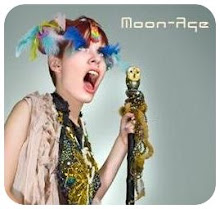
Style- Using Alexandra Moon-Age's collection of outrageous, colourful garments.
clashing patterns
high waist leggings
gaudy jewelery
dramatic collars
faux fur
desaturated colour
platform shoes
modern mish-mash glam
Photos will be shot using a white background using a fill flash. The shots of the models will be cross processed with images that were captured using a macro lens to gain extreme close ups of various materials. The object is rendered unrecognizable by the use of the macro lens so the emphasis is on colour and texture.
See below for an example of this effect-
Images shot by Emmett using macro lens
Date- August 18th 10.30am
Using fill flash-
To create a doll like effect
patterned backdops- Mosque on Kingsland rd
cross processing with graphic element
combining exposures